What Is Plastic Crushing? Its Role and Advantages in Recycling

Plastic has become an essential material in modern life. From packaging and automotive parts to home appliances and toys, we encounter it everywhere. However, this widespread use also brings a significant waste problem. That’s where plastic crushing machines come into play. What Is Plastic Crushing? Plastic crushing is the process

10 Surprising Facts You Should Know About LDPE

LDPE (Low-Density Polyethylene) is widely used across many industries, offering significant benefits to both the environment and businesses, from production to recycling. Yet, there are many lesser-known facts about LDPE. Here are 10 surprising facts to help you see LDPE from a new perspective: 1. Discovered in 1933 LDPE was

How to Earn Extra Income Through LDPE Recycling

Recycling is not only an environmental responsibility; it is also becoming a profitable income model for individuals and businesses alike. Especially in commonly used plastics like LDPE (Low-Density Polyethylene), the potential is even greater. So how can you make money from LDPE recycling? Let’s explore. 1. Collecting and Sorting Used

Why LDPE? The Smart Polyethylene Choice for Your Business

The choice of material affects every aspect of production — from quality and cost optimization to customer satisfaction and environmental responsibility. LDPE (Low-Density Polyethylene) has become the preferred solution for many industries. But why? 1. Flexibility and Processability 2. Cost Advantage 3. Wide Range of Applications 4. Eco-Friendly and Sustainable

The Power of LDPE: Make Your Products More Durable and Environmentally Friendly

Today, consumers demand not only quality products but also environmentally friendly, long-lasting and sustainable solutions. This is exactly where LDPE (Low Density Polyethylene ) comes into play. Quality with Durability Thanks to its flexibility and high impact resistance, LDPE has a wide range of applications from product packaging to building

Usage Areas of HDPE and PP Plastics

Plastic materials have become an indispensable part of modern life. Especially thermoplastics like HDPE (High-Density Polyethylene) and PP (Polypropylene) are widely used in various industries thanks to their advantageous properties. So, where do we encounter HDPE and PP plastics? In this article, we will explore the main usage areas of

Why Is Recycling Done?

Today, problems such as environmental pollution, depletion of natural resources, and climate change are leading humanity to seek sustainable solutions. One of the most important of these solutions is recycling. So, why is recycling so important? What is the purpose of recycling? In this article, we will discuss the purpose

HDPE or PP? Which Plastic Should Be Preferred in Which Industry?

The plastics industry offers many different types of polymers suitable for various needs and applications. The two most commonly used thermoplastics are HDPE (High-Density Polyethylene) and PP (Polypropylene). So, what are the differences between these two plastics, and which one should be preferred in which industries? Let’s take a closer

The Microplastic Problem in HDPE and PP Plastics

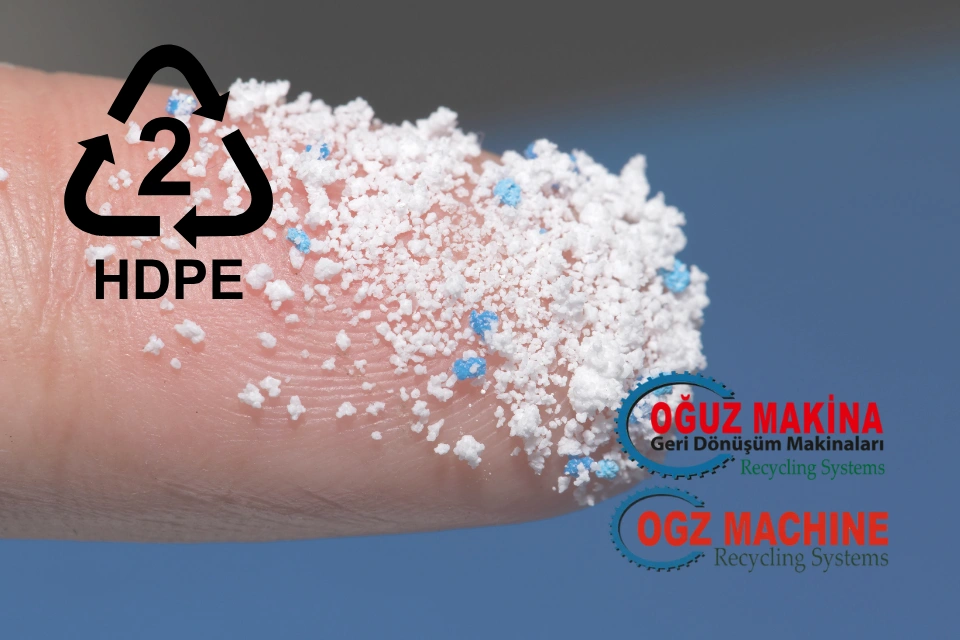
Plastics are among the indispensable materials of modern life. Especially HDPE (High-Density Polyethylene) and PP (Polypropylene) are widely used in many industries due to their durability, lightness, and chemical resistance. However, alongside these advantages, the microplastic problem—which has become increasingly prominent in recent years—poses a serious environmental threat. So, how

What is Microplastic?

Everything You Need to Know About Microplastics In recent years, microplastics have become one of the most discussed environmental issues. So, what are microplastics? Where are they found, and how do they harm our health and the environment? In this article, we cover all the details you need to know

İnönü, 167 Sokak No: 13, 35870 Torbalı/İzmir
Pzt. - Cum. 08.30 - 18.30
+90 (232) 254 71 61

Kısayollar

Sosyal Medya